



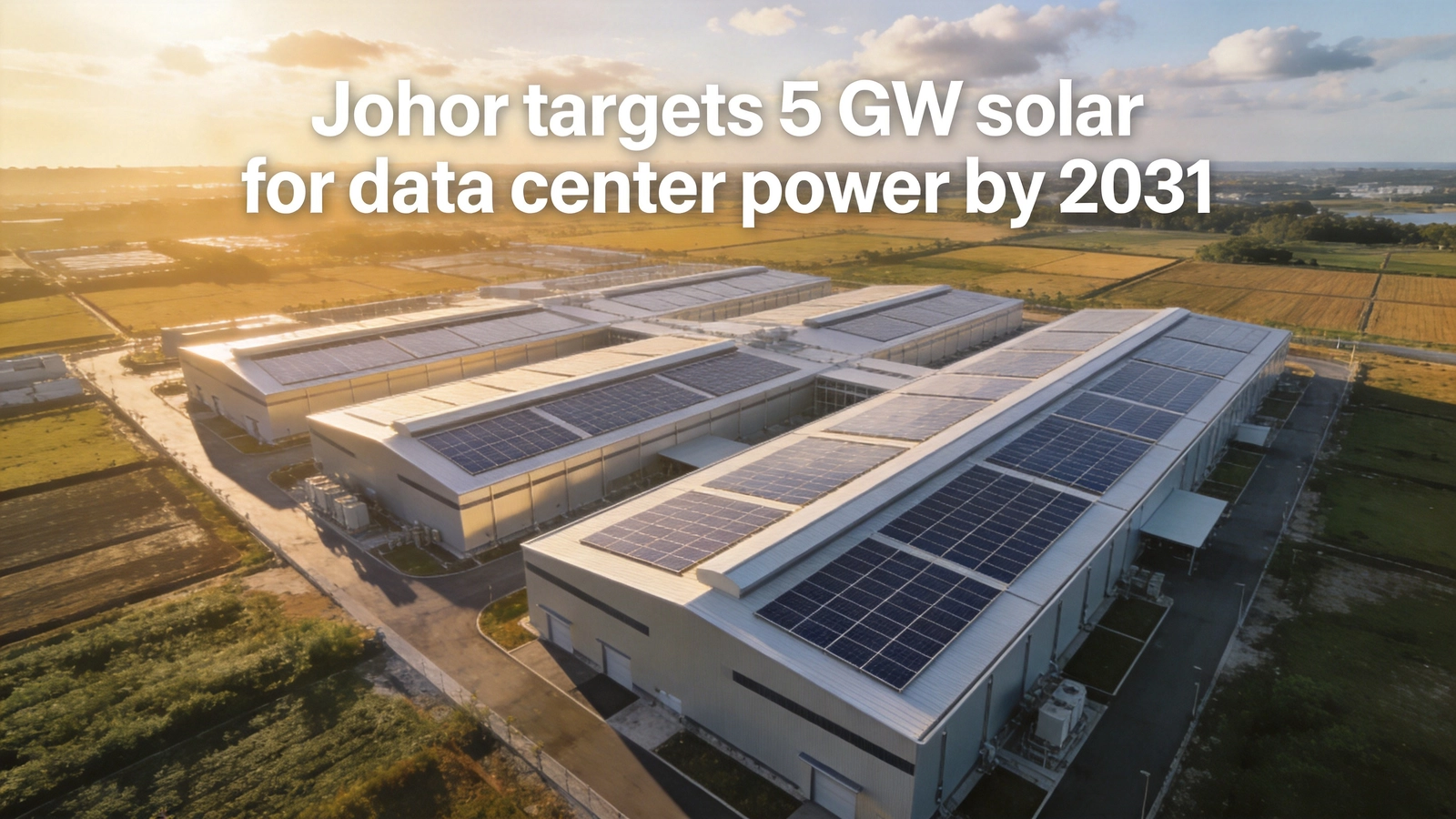
Lee Ting Han, chairman of the state Investment, Trade, Consumer Affairs and Human Resources Committee, described the measures as long-term plans, noting that developing new electricity generation capacity requires considerable time. Both the Johor and federal governments are actively pursuing additional generation through solar projects, off-grid solutions, and new tenders issued by the Energy Commission. The commission, operating under the Ministry of Energy Transition and Water Transformation, has issued tenders for an additional 8 GW of capacity across Peninsular Malaysia, with a substantial portion expected to be allocated to Johor. Specific solar projects include 4 GW planned for Kota Tinggi and Mersing, with implementation slated to begin in stages from mid-2029, alongside another 1 GW solar project planned for Segamat.
The development carries significant implications for Southeast Asia's data center landscape. Johor has emerged as a key alternative to Singapore for hyperscale and colocation operators seeking land and power, but the state's ability to deliver renewable energy at scale will determine whether that advantage is sustainable. The coordination committee's PUE assessments signal a shift toward stricter efficiency standards, while the reliance on solar and off-grid solutions reflects a broader regional push to decouple digital infrastructure growth from fossil fuel dependence. How quickly Johor can bring its solar pipeline online will be closely watched by operators weighing long-term commitments in the region.