



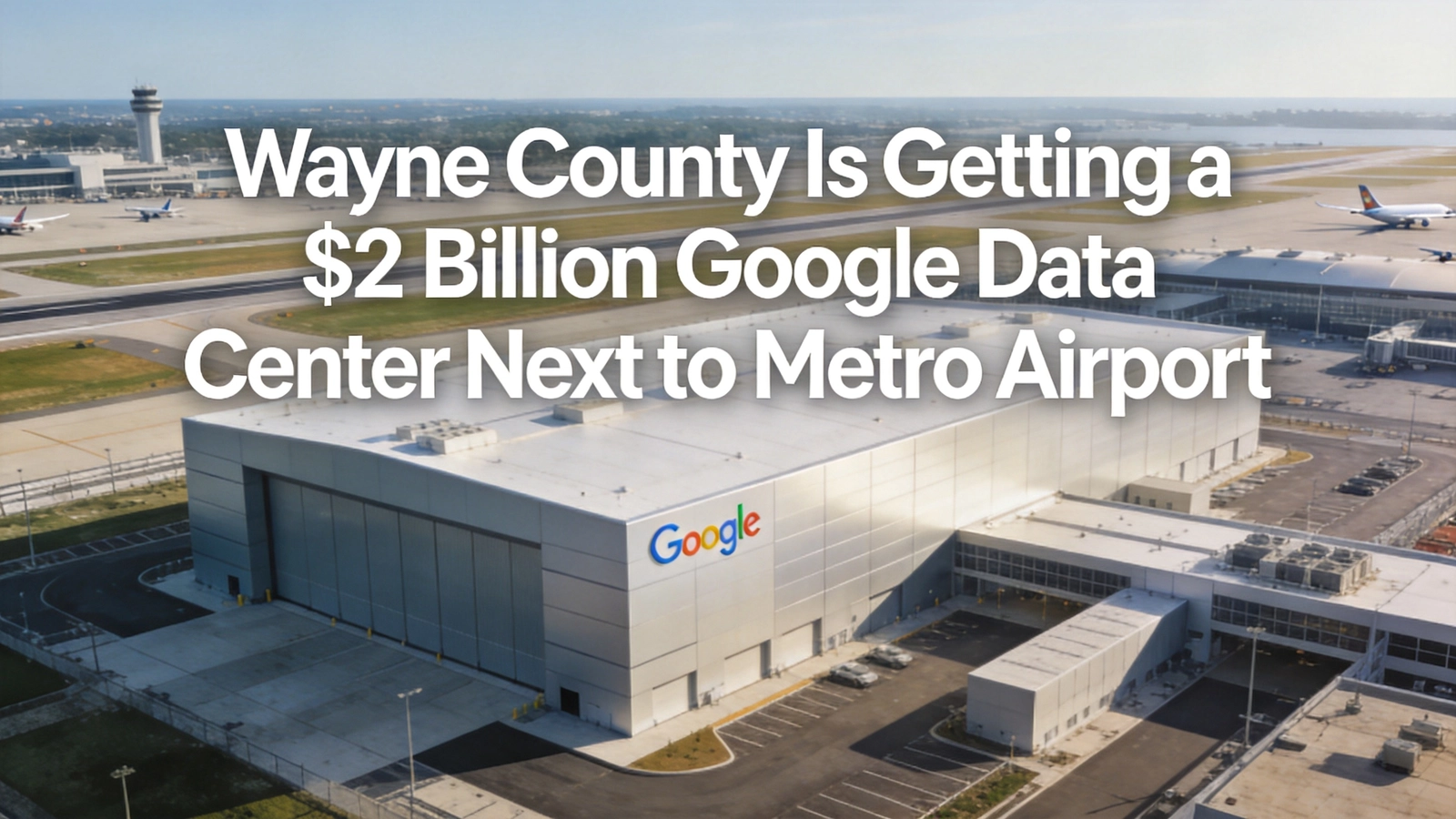
At full load, the facility is expected to draw approximately 1 gigawatt of power, according to Google and DTE Energy. DTE has told state regulators that service should begin in December 2027 and reach maximum load by December 2028. Water consumption is projected at 2 million to 3.6 million gallons per day — roughly equivalent to the entire current demand of Van Buren Township, which averages 2.56 million gallons daily from the Great Lakes Water Authority. Under the township's development agreement signed May 19, the township must negotiate a new contract with GLWA to increase its contractual water capacity, with the developer or end user paying for a rate study and signing a special rate agreement. Paul Kammer, a Fishbeck consulting engineer for the project, told the planning commission that the data center's water will not draw from the township's existing system, meaning the supply would come through added GLWA capacity purchased for the site. For context, the campus would use roughly as much water as Southgate or Lincoln Park, and between 0.6% and 1% of GLWA's entire 356-million-gallon daily system serving 88 communities. Backup generators were reduced from 150 in early plans to 20 following township review, cooling towers were updated, and berms were added to screen the site. The state issued a joint wetlands permit for the site on Aug. 19.
The electricity arrangement was settled separately on Oct. 1, when the Michigan Public Service Commission unanimously approved a 20-year contract between DTE Energy and Google. Under the agreement, Google will pay for DTE to develop up to 1,600 megawatts of renewable energy and 480 megawatts of battery storage, and must cover at least 80% of the power it contracts for even if it uses less. If Google exits early, it owes a termination payment covering at least 15 years of those minimum charges. DTE spokesperson Ryan Lowry stated that "Google will cover the full cost of powering its data center," and the commission said other customers should not bear the project's costs. Attorney General Dana Nessel had pushed for a 90% minimum and a larger exit payment, warning of stranded assets if the data center uses less than forecast or closes early. Katie Duckworth, a staff attorney at the Environmental Law and Policy Center, criticized the commission for failing to encourage large, financially capable customers like Google to develop and fund distributed energy solutions. It was Michigan's first hyperscale data center decision made through a contested case.
The financial incentives package proved equally contentious. In May, Van Buren Township approved $125 million in local tax incentives cutting certain property taxes on the development by half for 12 years. In September, Wayne County Executive Warren Evans vetoed the county's share, citing a rushed process and lack of public input and independent analysis. On Oct. 1, the Wayne County Commission overrode him 13-0 with two members absent. In exchange, Google agreed to pay $15 million each to the county and the township and to fund a community benefit account that the county may use for senior services and low-income housing. Panattoni projects $2 billion in construction contracts for Wayne County businesses, and once open the facility will employ 50 to 200 people on site and become the township's largest taxpayer.
Public opposition remains vocal. More than 2,700 people signed a petition against the project, and recall efforts have started against some township trustees who backed it. At the Oct. 14 meeting, nearly an hour of public comment preceded the vote. Resident Maggie Brumar described "the constant, it's every half hour, dumping of the dump trucks" from site work already underway, while Joe Jones called Google "one of the most ruthless" companies in the world and Mickie Wordhouse said she is "hoping that Google comes through for all of us." Commissioner Bernard Grant cast the lone no vote, while Commissioner Jeff Jahr, who voted yes, said the commission's job is to "verify that the construction is in line with the law."
Panattoni can now proceed with utility installation and site improvements. The next battleground is the power deal: on Oct. 30, Attorney General Nessel filed a petition asking the commission to rehear the Google contracts in case U-22058, arguing the order lets DTE's other customers subsidize the data center for stretches of the 20-year term, including a four-year period from 2035 to 2038 that the commission itself acknowledged. She wants costs and benefits reconciled annually rather than over the whole contract. The recall efforts against trustees will also reveal how much political cost the vote carried. The facility is expected to begin service in December 2027 and reach full load by December 2028.