



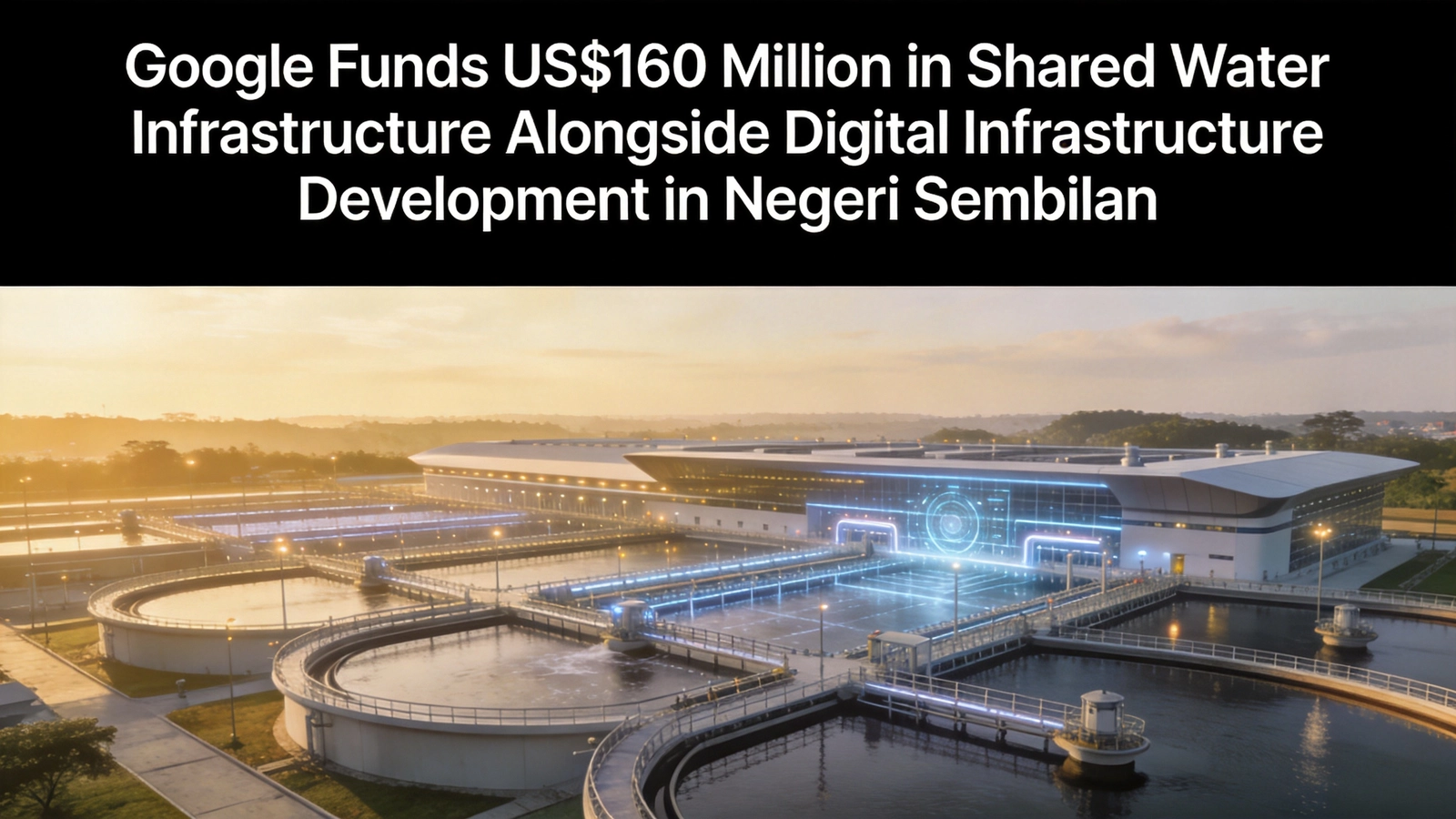
In coordination with the State Government of Negeri Sembilan and Syarikat Air Negeri Sembilan Sdn Bhd (SAINS), Google has appointed Gamuda Berhad to construct an off-river storage reservoir and water treatment plant. Upon completion, the facilities will be owned by Menteri Besar Negeri Sembilan (Incorporated), or MBINS, the statutory body under the State Government that manages state assets. Once operational, the plant will have the capacity to deliver 65 million liters of potable water daily, serving not only Google's upcoming data center campus in Springhill Industrial Park, Port Dickson, but also expanding the state's public water supply.
The off-river storage reservoir, located along the Linggi River, is designed to capture excess river flow and rainfall, particularly during high-yield seasons, to help mitigate flood risks in surrounding flood-prone areas. The captured raw water is then channeled through the treatment plant for purification for domestic and commercial use. During lower-yield periods, the plant can draw directly from the reservoir's reserves, maintaining a resilient water supply for the community without disrupting the river's natural flow.
Google's digital infrastructure development in Negeri Sembilan encompasses the data center campus, the shared water infrastructure, and targeted education and workforce development programs. The company will pay for 100% of the power its data center campus uses and the direct infrastructure costs required to connect it to the grid, while complying with all applicable local regulations. Google's commitment to the state spans the construction phase and the multi-decade operational lifecycle of its campus. The planned data center campus in Port Dickson is custom-designed to be among the most energy-efficient in the world, and once operational, its advanced computing capabilities will power Google services including Search, Maps, and Chrome, used daily by millions of individuals and organizations across Malaysia.
Dato' Haji Najmuddin Sharif bin Sarimon, Chief Executive Officer of Invest Negeri Sembilan, said Google's planned campus represents an important milestone in the state's journey toward becoming a competitive destination for high-value digital infrastructure investment, demonstrating how private investment and public interests can be aligned from the outset to deliver sustainable, long-term benefits. He noted that attracting investment is not simply about the size of the capital committed, but also about the quality of investment, its long-term economic contribution, and its ability to create value for the people.
Drew Byrnes, Director and Head of Global Infrastructure and Energy, Asia Pacific at Google, said the decision to fund shared water infrastructure reflects the company's global ambition to replenish 120% of the freshwater volume it consumes, even as its water risk assessment showed that local water sources were not at high risk of scarcity or depletion. He emphasized the company's responsibility to grow its presence sustainably by pairing advanced digital infrastructure development with water replenishment projects, power infrastructure enhancements, and programs designed to upskill local talent.
Alongside its water commitments, Google has been partnering with consortiums led by Shizen Energy-Solarvest and TotalEnergies to add net-new clean power to Malaysia's National Grid through Power Purchase Agreements, which provide the bankability and upfront guarantee of future revenue that energy developers need to secure financing for new clean energy generation facilities such as utility-scale solar farms.
Google is also expanding its collaboration with SOLS Foundation to launch two initiatives. The Solar Explorers and Solar Futures initiative will establish a Solar and Energy Lab, equipped with a 2.56-kilowatt-peak solar array and 5.4 kilowatt-hours of battery storage, in each participating public school, with teachers trained to use the labs for interactive lessons. Additionally, Google is funding and establishing Digital Skills for the Renewable Energy Workforce, a specialized 36-hour training track that will serve as a permanent core pillar of the SOLS Solar Academy program, equipping youth from lower-income backgrounds and Indigenous communities to enter skilled trades in clean energy with job placement upon graduation. These initiatives are set to roll out in Negeri Sembilan in early 2027.