



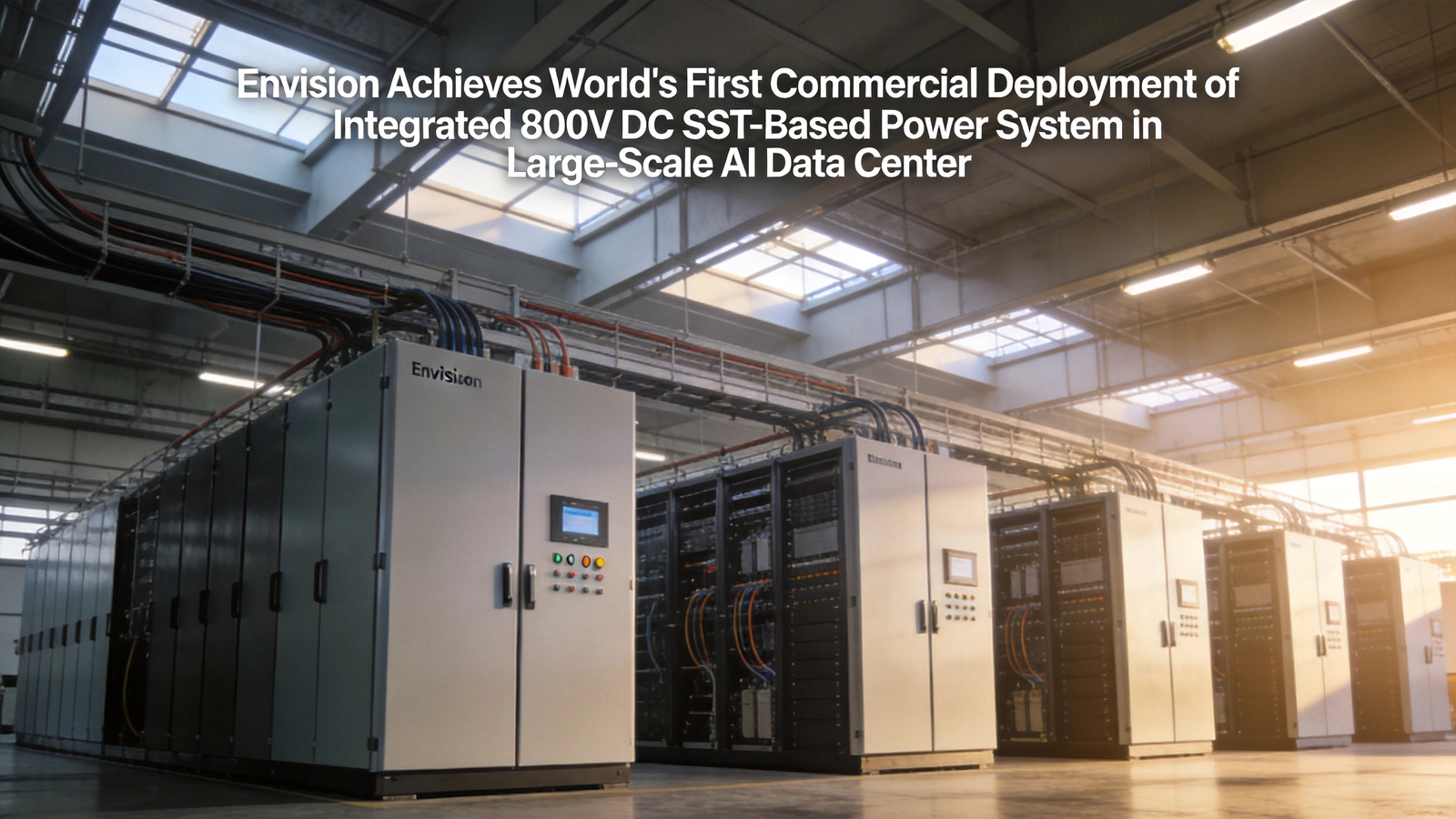
The integrated system combines solid-state transformers, battery energy storage, and equipment that regulates direct-current voltage for computing hardware. Envision's Dubhe Controller, supported by its Dubhe Energy Foundation Model, coordinates the transformers and batteries in real time to match power supply with computing demand and manage sudden load swings. The system is built around three core capabilities: stable solid-state transformer conversion directly from 10 kV medium voltage to an 800V DC bus across operating conditions; battery storage providing both second-scale power support and minute-scale backup; and millisecond-level coordination between the transformer and storage components to absorb GPU load fluctuations locally.
"AI data centers need power systems that coordinate renewable energy, energy storage, and the grid to meet computing demand," said Kevin Huang, Senior Vice President of Envision Energy and President of Energy Storage and AIDC Power Systems. "Our integrated 800V DC system is now powering live computing workloads, demonstrating an end-to-end architecture that connects renewable energy supply with computing demand. This is a critical step in turning power-compute coordination from a strategic vision into an operational reality."
The Galaxy campus began operations in August 2026 and is planned to reach 3GW of capacity, designed to support up to one million AI accelerators operating in parallel at full build-out, with more than 80% of its power planned to come from direct renewable electricity connections. Envision aims to scale the approach through its Mission Gobi initiative, which targets 5GW of green AI data center capacity in desert regions worldwide by 2030. The commercial deployment provides a reference architecture for the broader industry as it advances its transition to 800V DC infrastructure for next-generation AI data centers.