



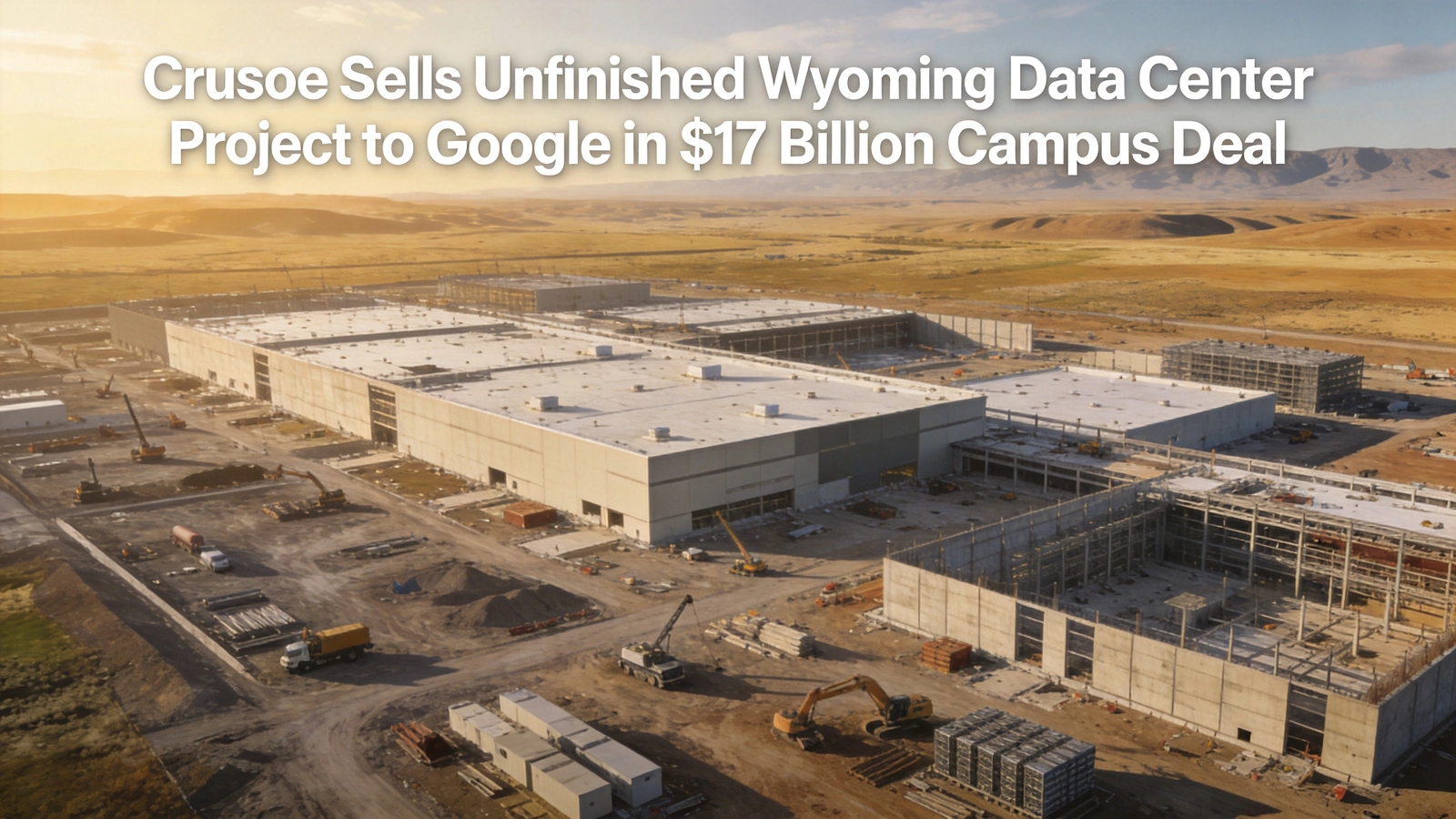
Crusoe originally unveiled the project last year in partnership with Tallgrass, a Blackstone-backed infrastructure company, with plans to eventually scale the campus to 10 gigawatts of power capacity. The deal to sell the site to Google was first reported by Bloomberg in June. Despite the Wyoming setback, Crusoe closed a $3.9 billion funding round in September, demonstrating continued investor confidence in its broader business model.
The Wyoming project's transfer highlights how difficult it can be for independent developers to bring large-scale data center projects to fruition, given persistent challenges in securing equipment and power. Growing opposition from local communities can further complicate development timelines and cost structures.
Google has not walked away from working with Crusoe entirely. Crusoe is developing another data center for Google near Amarillo, Texas, preserving a working relationship between the two companies even as the Wyoming project changes hands.
Crusoe generates revenue by leasing data center space to customers that supply their own GPUs, renting out its own GPUs, and selling compute power used to run AI inference workloads. Its largest projects serve some of the most prominent names in artificial intelligence. The company's campus in Abilene, Texas, is being built in phases for Oracle and OpenAI, and Crusoe is also constructing a separate 900-megawatt campus next door for Microsoft, with its first building expected to come online in mid-2027. Meta is also a customer, and Bloomberg reported that trading firm Jane Street signed a $13 billion, five-year cloud deal with Crusoe.
Crusoe was founded by Chase Lochmiller, now its CEO, and Cully Cavness, who started it as a cryptocurrency-mining business powered by natural gas that would otherwise have been flared. In September, alongside its $3.9 billion funding round, the company added three board members, including JB Straubel, the Redwood Materials founder and Tesla board member who invested in Crusoe in 2021. Crusoe later became the first customer of Straubel's energy-storage business.
The Wyoming sale reflects a broader trend in the data center industry, where hyperscalers are increasingly taking direct control of large-scale projects to ensure they meet ambitious timelines for AI infrastructure buildouts. For independent developers like Crusoe, the episode illustrates the tension between rapid expansion ambitions and the operational risks inherent in delivering gigawatt-scale facilities.